
INTERVIEW: Qiuqiu of Chinese Powerviolence Band CHOU Based in Scotland [China/Scotland]

INTERVIEW | Qiuqiu
Drummer
Chou
We continue with our focus on immigrants in the UK killing it in the heavy music scene here. Next up, our buddy Qiuqiu, drummer of grindcore band CHOU who is originally from China. It’s a cool read talking about his experience growing up in China and then his move to Scotland. He gets into TONS of details which makes it such an enlightening read.
It’s always fun trying to line up interviews. Totally understandable that some people aren’t sure whether they have anything important to say, but as you’ll see from reading this interview, homie unleashes gem after gem of quotable thoughts and ideas.
Let’s go.
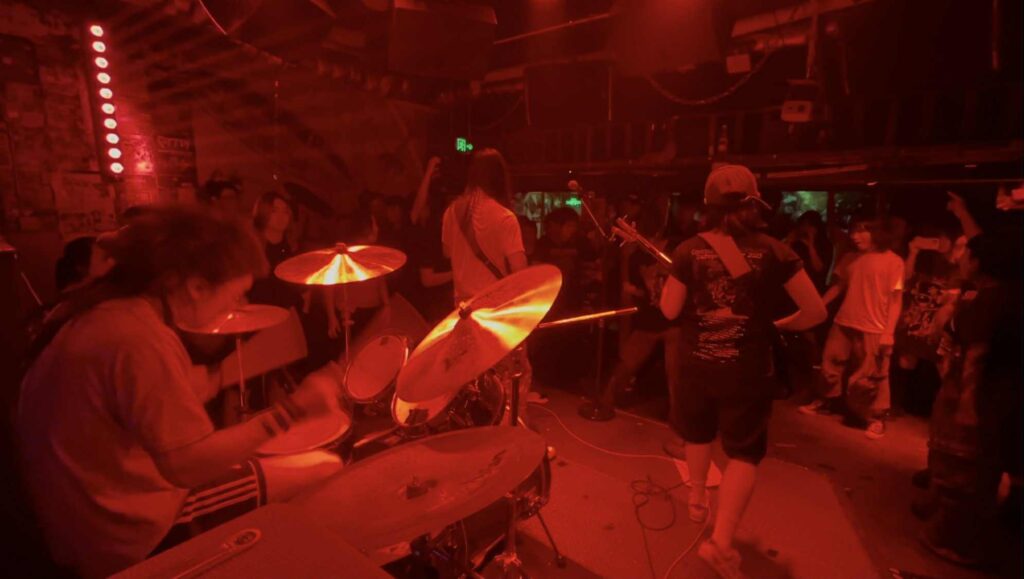
UA: Thanks for doing this interview. Can you tell everyone what your name is, your ethnicity, and what band you’re currently playing in.
Qiu: Hi folks, here is Qiuqiu. I’m a Chinese who moved to Scotland four years ago. Some people know that my real name is Yilin Qiu, and I think here is a good chance to clarify. I got ‘Qiuqiu’ as my nickname in high school, as our school football team coaches always called me like that. It happens in my hometown sometimes, when you’re close to someone, they’ll repeat your name twice. I like both, but I’ve grown used to everyone calling me by my nickname; it sounds rather endearing. In the UK, some folks say it sounds like a train whistle, which is quite fun.
Currently, I play drums for C.H.O.U., AKA Chaotic Humanity Observation Union. I also shout as the main vocals.
UA: Sick! Yeah because I’m from Hong Kong and my name is one syllable “Riz” my friends always added “ah” in front of it. Hahaha so my name is “Ah Riz” it took me so long to understand this! Even though I grew up there! So what city are you originally from and why did you decide to move to the UK?
Qiu: I know exactly what you mean! I’ve never been to Hong Kong, but I’m a huge fan of Hong Kong films and have picked up a fair bit of Cantonese from them. I was born in Zigong, a city in Sichuan province, south-west China, famous for its salt industry, dinosaurs and lantern festivals. The local cuisine is famous as well, renowned for its spiciness. Most people there can handle a lot of heat, and so can I. As such, after arriving in Britain, I struggled for ages to find serious chillies for cooking until I discovered Scotch Bonnets.
My initial move to the UK was for studies. In summer 2018, I travelled with my undergraduate college to the University of Ulster for an IFA coaching course. Though we only visited London and Belfast, it was enough to form my first impressions of here. Aye, I studied sports science and spent half my life playing football. Later, in 2021, I went to the University of Edinburgh for my master’s degree. After graduating, I stayed in Scotland to work till now. Another reason was my desire to experience a different culture; my hometown and Edinburgh felt like two entirely different worlds. I’m not suggesting one is superior to the other, but rather that culture shock is very real, just gradually fading with time. I still remember my first day in Edinburgh, stepping out of Waverley Station and catching sight of three young men in full formal attire, wearing kilts, chatting and laughing as they passed by. At that moment, I thought to myself, well, wise choice. I like this place where men can wear skirts.
UA: Hahaha…true, there are definitely parts of the UK where you can truly be whoever you want to be. Places like Brighton, Bristol, Manchester to me have been places where you can do that. My band KING LY CHEE has played in Chengdu I don’t know how many times hahaha…such a great city with lots of good food! When you were in China how did you get into heavy music? And what were some of the bands that spoke to you?
Qiu: I would say it is a gradual process. In my hometown, the extreme music scene is virtually non-existent, and people seem to be expected to lead lives that conform to the rules. When I was about ten, BEYOND (Surprise? Haha!) and The Beatles opened my inner world. These two are my endless treasures that I still listen to from time to time.
Due to limited information and resources, I could only strive to absorb any interesting sounds online, and found giants like Megadeth, Therion, and Guns N’ Roses in secondary school. When music came up in conversation, classmates were engrossed in Mandarin Pop or K-pop, etc., and I was like a freak. Later were Nirvana, Motörhead and Slayer… Until I discovered Discharge during my undergraduate. That’s when I truly entered the underground world of heavy music, realising my deepest affection lay with fast, intense punk/hardcore music brimming with social and humanistic concern. I believe music is humanity’s attempt to find emotional resonance through sound, and these genres revealed to me that the energy of music and musicality aren’t inseparable.
Having spent my undergraduate years at Central China Normal University in Wuhan, it was inevitable that the city’s underground scene left a profound mark on me. S.C.O.D., 脑脑死, and SMZB were all dear to my heart. Actually, Wu Wei mentioned to me that you invited him to start a new hardcore project, after he moved to England. Beyond that, EXPLOSICUM from Nanchang must be mentioned – their hyper-fast thrash metal lives always drove me wild. Oh, and Beijing’s DEAR ELOISE, my favourite Shoegaze ever, who only write songs and never play gigs. Nowadays, I’ve gradually drifted from the scene developments in China, but new bands like Kunming’s PPT and Beijing’s RUST SUCKER cannot be ignored.
UA: Do you remember how you found bands like Megadeth and then Discharge? Was it online or did you somehow find people who were already listening to it?
Qiu: It was a combination that happened online. It all began when I started spotting bands on Baidu Tieba, which was China’s most popular online forum at the time. People would list their top ten metal albums and such. After that came infinite self-exploration, because I couldn’t find anyone to chat about this stuff with in real life, until I got to Wuhan, where I gradually met more folks with similar musical preferences.
UA: Yeah Wuhan being a punk Mecca is always so cool. The first time I played there was in 2000 and I stayed at Wu Wei’s house hahaha do you remember what connected for you with this music? Was it the music, the lyrics? What did you like about it?
Qiu: For me, music comes first, then lyrics. Sometimes, if the music itself doesn’t attract me, delving into the lyrics feels like a waste of time. Yet, on the other hand, lyrics can be the most crucial component, as language and words offer creators a shortcut to express their thoughts and convictions more effectively than melody and sound. Overall, it’s a certain aura, a shared, free-from-vulgarity found across underground punk genres that catches me most. Musically, it might be the raw, primal textures or rapid and heavy riffs; lyrically, it could be radical ideologies or utterly delusional nonsense. Visually, that anti-commercial/mainstream DIY style ensures they remain distant from the rest of the world.
UA: So when you first heard bands like Megadeth and Discharge is that what drew you to them? I’m just wondering what attracted you to their music when you first heard them?
Qiu: The initial reason was simple enough: those addictive riffs. When I first got into bands like Megadeth, I was probably only 13, a complete layman. Whether it’s the technically intricate arrangements or the raw, direct punk-inspired ones, their pace and impact kept me coming back for more. As for the deeper understanding behind the music, that came later, through gradual accumulation over time.
UA: I think that’s what I’m trying to find out. To me, I got into metal first and when I first punk and hardcore I actually didn’t like it. It wasn’t until I saw it live and learned the ethics, the culture, the activism behind it that I got interested in it.
Qiu: We are quite similar at this point, got into metal first, then punk/hardcore. Though both genres have a comparable number of subgenres, I think metal holds greater mainstream market appeal and is more accessible than punk. I’m not including pop-punk and the like here just in case. As for things like Powerviolence and Grindcore, they can genuinely leave one bewildered when first encountering them. “Ten seconds per song?”
“We are all Chinese, and we always know what happens in our distant homeland while we are in the Western world, while things close at hand in the West are inevitably reviewed through minds rooted in China.”
UA: What was your first “show” you ever saw? What bands were playing, where was it, and what do you remember from that show?
Qiu: I really can’t recall…Perhaps it was a foreign band’s tour, definitely at some venue in Sichuan Province. But I do remember feigning illness to skip school and sneak out to catch gigs back in high school, and travelling alone by train for over twenty hours to Beijing to see Megadeth just before my university entrance exams. Crazy time goes by.
UA: When did you start playing in bands? And what were your first bands like?
Qiu: Can’t remember the exact year but I started playing band as a guitarist in middle school, once I learned a few solos and riffs from Beyond. Nothing serious, other folks were from different schools and we mainly played some Beyond covers until I went to another city for high school. Short life but well enjoyed.
UA: People out here in the west will never understand the power of a band like Beyond – the fact that you were in Sichuan singing songs in Cantonese is so frickin’ cool. So when did first venture into playing in punk and hardcore bands?
Qiu: Their influence in China is absolutely massive. At least everyone in my generation could sing one or two of their songs. That’s how I learnt Cantonese since young lol. I’m not sure how the new generation reacts, but my auntie is a huge fan of Beyond too.
I would say C.H.O.U. was my first serious attempt. Earlier still…around 2019? During university holidays, I dabbled in Crossover Thrash/Hardcore for a while in Chengdu, but it never progressed beyond rehearsals. We were just a few mates who enjoyed metal, scattered across different cities. No one felt we had to achieve anything, as getting together was already quite an effort. The band gradually faded away, then became an excuse to have dinner out, whenever I returned home.
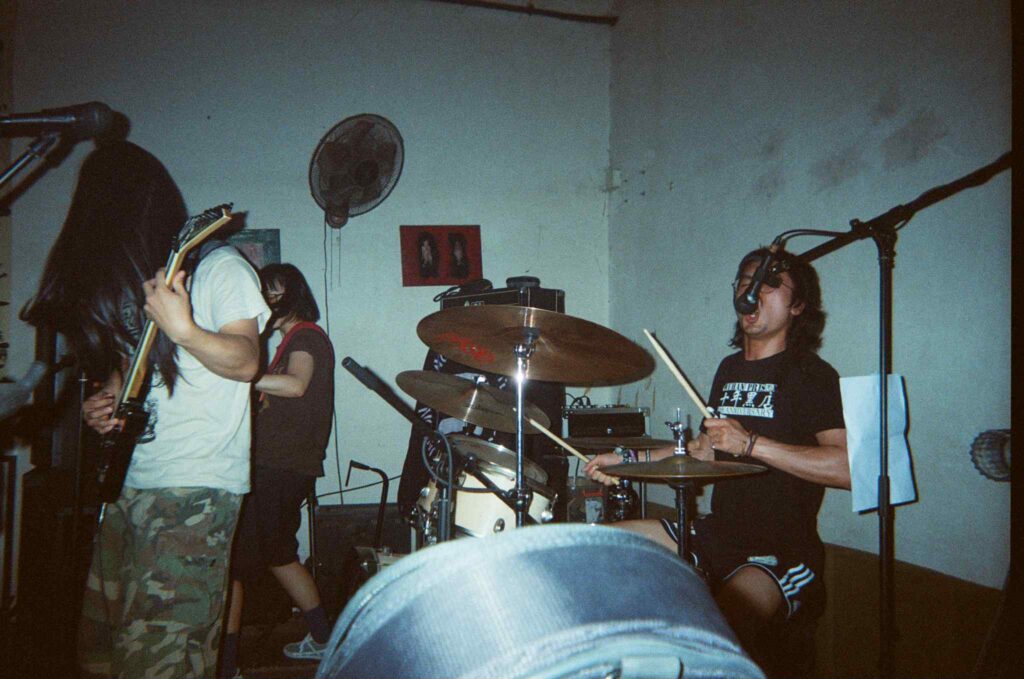
UA: Nice! So tell me how CHOU got together before your whole band are Chinese remember living here in the UK which is so cool. How did the band start and how’d you all settle on this sound?
Qiu: Long story short, we didn’t know each other in China, and the story began in Scotland. We all went to study at the University of Edinburgh in 2021. Through a mutual friend, I met our bassist Xi, then she introduced me to our guitarist Keming. Actually, we just watched gigs together and jammed a few times, until we formed C.H.O.U. in autumn 2023. On one hand, I have desired for years to build an extreme hardcore band but haven’t acted on it; on the other, I recognised their playing skills were steadily improving, so the timing felt right. I asked if they fancied playing some intense, fast music, and both happily agreed. But lacking a drummer, I picked up the drumsticks again and explored practising. Thus, C.H.O.U. finally took shape.
Regarding our style, as I lead the song writing and am deeply into Powerviolence and D-beat, C.H.O.U.’s sound gradually becomes a fusion of these two genres. Yet during the exploration, we didn’t confine ourselves to this narrow path. Our split EP with PPT released tracks rooted in Crust Punk and Sludge Metal from our early years. Later, C.H.O.U. incorporated elements of Chinese traditional music. Blending the raw intensity of hardcore with the understated elegance of Chinese melodies is something improvised and special, folks will feel that in our new songs.
UA: And what’s the reception been to you guys since you’ve been playing out? There aren’t a lot of us Asians involved in hardcore, punk or grindcore here?
Qiu: Personally, I think it is not bad at all. We don’t play many gigs, but the crowds always seem to get into it. Perhaps “Chinese Powerviolence based in Edinburgh” is impressive enough haha. I’m always pleased when someone asks about the meaning of our Chinese lyrics, though many enjoy the music itself and get moved by it. We don’t really sell much merch online either, so sometimes seeing people DIY our patches is a nice surprise.
UA: Sick sick – as a hardcore website, I’m really interested in lyrics even more so than the music sometimes. What do you guys sing about? I mean, since you’re all located here in the UK, I wonder if you’re able to sing about things that you would normally not be able to sing about elsewhere?
Qiu: Rights exploitation, war anxiety, state machine, identification, self-reflection… In general, every lyric we write serves as a testament to our full name – a series of chaotic events stemming from chaotic humanity, alongside a highly subjective experience of human nature.
Regarding the second question, yes, there is. After all, the interpretation of free speech across different places on this planet is as varied as the diverse forms of taxation. But it hasn’t bothered us that much. This is because I prefer leaving a more imaginative space for the listener rather than direct accusations. Naturally, this includes lots of metaphor and sarcasm. Some lyrics are quite subconscious, making them too personal. Yet all our songs share a common point: “observation”. We are all Chinese, and we always know what happens in our distant homeland while we are in the Western world, while things close at hand in the West are inevitably reviewed through minds rooted in China. C.H.O.U.’s content is a complex and detached fusion born of this background. Thus, I endeavour to capture what I observe and express it in my own way. I do not impose my concepts upon others, but if they are moved to consider more, that is generally enough.
UA: Nice – so as we wrap up this interview. Racism has been on the rise espeically against people like me – brown, Muslim, immigrant. Have you experienced anything since you’ve been here?
Qiu: Yes, but I believe racism has never truly waned in modern society. It can be excused by “wrong history” or by “we are better than they”. In Shanghai, Liverpool, Edinburgh, Madrid… I’ve experienced all manner of special greetings. People with skin as brown as yours sat in their car, mockingly said “yellow guys” to me and my friends; a white man seriously told me Chinese people “should cycle everywhere like in Beijing decades ago”, while Britons drive because “car culture is part of our historical tradition”. During an anti-racism quiz in work training, one question asked whether white people could experience racial discrimination. I chose yes, but the correct answer was no. Often, the world is not as we imagine it to be. Understandably, people have ethnic pride based on social attributes, but there are always those who elevate this to racial terms, seeking a sense of superiority over others. To me, it is another example that refers to our band name. By the way, C.H.O.U. also has a Chinese name, 丑 (chǒu), which means ugliness.
UA: Yeah racism exists everywhere that’s for sure. Any dominant race will have people who look down or vilify minorities. It’s just the way the world works. Humans all suck at the end of the day. Any last worlds as we wrap this up?
Qiu: No I’m fine. I think that’s me mate.

You may also like...


-

DEMO ALERT: Taiwan Unleash Debut Demo by Beatdown Band GUNPOINT [Taiwan]
Check out a brand new Taiwanese hardcore band called GUNPOINT, who’ve just dropped their debut demo ‘Don’t Ever Stop Moving’. The band were kind enough to send us some...
-
-

REVIEW: Hong Kong Post-Hardcore Act Wellsaid Release Sophomore Album ‘Lurking’
-

REVIEW: Hardcore Punk Act SPIT Release Self-Titled Debut Album [Taiwan]
-

REVIEW: Melodic Death Metal Band Reborn Release EP [Vietnam]
-

REVIEW: The Most Important Punk Rock Release of 2021 – The Rebel Riot [Myanmar]
-

REVIEW: Metalcore Band Prompts’ ‘Magenta Smile’ Gets A Full Review [Japan]
-


